Bowtruckle
Fantastic Beasts and Where to Find ThemThe Bowtruckle is a tree-guardian creature, described as peaceable and intensely shy but capable of leaping at a woodcutter when the tree in which it lives is threatened. Its entry gives that contrast a precise ecological basis: the creature’s life is bound to a particular tree, so its defensiveness is presented not as general aggression but as protection of its home.
Identity and Appearance
The account identifies the Bowtruckle as a tree guardian found mainly in western England, southern Germany, and certain Scandinavian forests. It is exceptionally difficult to spot: at a maximum of eight inches tall, it is small enough to disappear among its surroundings and appears to be made of bark and twigs. Its two small brown eyes are the only specific feature distinguished from that wooden, camouflaged form.
Temperament and Habitat
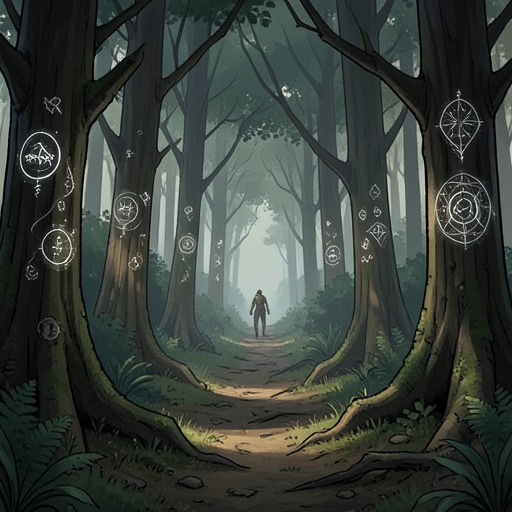
The Bowtruckle eats insects and is characterized as both peaceable and intensely shy. Its preferred habitat is not described as a forest in the abstract, but as the living tree in which an individual resides. That relationship makes the tree more than cover: when it is threatened, the Bowtruckle may leap down upon the woodcutter. The account thus connects its ordinary withdrawal with a sharply conditional defense, tying its action to disturbance of its home.
Protection and Magical Creature Management
The Bowtruckle’s portrait belongs to a wider account of magical-creature care in which governing bodies are responsible for the concealment, care, and control of magical beasts, beings, and spirits. The guide presents safe habitats as one of the most important means of concealment, while other interventions address the risks created by trade and breeding. The Department for the Regulation and Control of Magical Creatures strictly watches the trade in fantastic beasts, and the 1965 Ban on Experimental Breeding makes the creation of new species illegal. These measures are part of the management context around the creature, not specific regulations said to apply uniquely to Bowtruckles.
That policy framework holds protection and secrecy together without making them identical. The guide acknowledges occasional breaches of the concealment rules, and it describes remedies ranging from safe habitats to Memory Charms and, in the worst magical-Muggle collisions, intervention by the Office of Misinformation. The Bowtruckle’s dependence on an undisturbed host tree gives the habitat principle a species-level meaning: concealment can also preserve the conditions of a creature’s life, even as the larger system is designed to keep magical beings hidden from Muggles.
Significance
The Bowtruckle’s small scale and shy temperament make its defensive response more striking, but the account does not frame it as a monster to be subdued. Its aggression is conditional and legible: the threatened tree is the circumstance that changes its behavior. Set beside broader policies of habitat protection, trade supervision, and secrecy, the creature’s brief encounter with the woodcutter illustrates how human activity can become a direct pressure on magical wildlife, and how protection begins with recognizing the creature’s attachment to its home.